
How to Use Stencils Creatively in Mixed Media Art
Have you ever felt a little doubtful about using stencils in your art? Maybe it feels like cheating somehow, or not quite creative enough. Almost as if the stencil is doing too much of the work for you.
Or maybe you’ve used stencils before and felt that the result looked a bit flat. A bit too perfect. A bit like it was sitting on top of the painting, instead of becoming part of it.
If so, you’re not alone.
I’ve used stencils in my mixed media art for many years, and they show up in almost everything I create. But I don’t really think of a stencil as “a pattern” that I’m adding to my art. For me, a stencil is just another mark-making tool. Something to play with. Something to layer, break apart, soften, cover up, scratch into, and let disappear a little.
I’m not trying to get a perfect stencil print. I’m looking for those grungy, imperfect, interesting little marks that add texture, depth, and a sense of personal voice.
Over the years, I’ve found that the magic often happens in the small sections. A broken edge. A faded shape. A hint of pattern peeking through from underneath another layer.
That’s when the stencil stops taking over.
And starts becoming part of the painting.That is when the stencil stops taking over and starts becoming part of the painting.
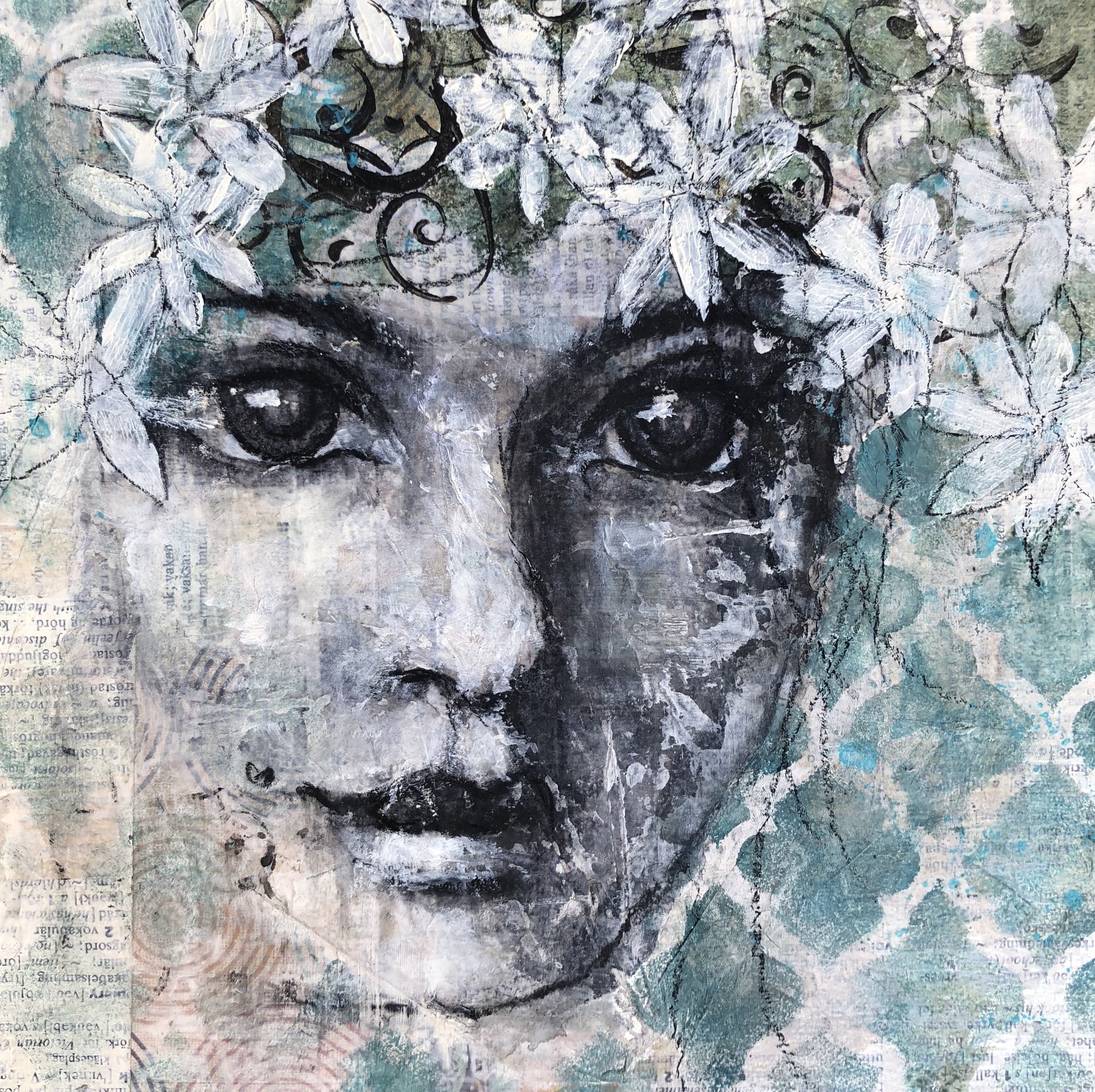
I have lots of fun using multiple stencils and just layering the pattern and color until it reflected how I feel
Why perfect stencil prints can make artwork feel flat
When I first started using stencils, I probably did what many people naturally do and began using every part and filling every open space to create a clean, complete pattern. I wanted to use the stencil properly, and I thought that meant showing every part of the design.
There is nothing wrong with doing that, especially when you’re first experimenting.
But over time, I noticed that the paintings I connected with most weren’t the ones where the stencil stood out clearly, they were the ones where it supported my own work, adding interest and layers..
If the pattern is too perfect or repeated too carefully, it can start to feel as though you’re simply colouring in the spaces someone else has created.
Your own marks can become quieter, and the stencil becomes the main event.
These days, I’m much more interested in what happens when the pattern is incomplete.
How I use stencils as a mark-making tool
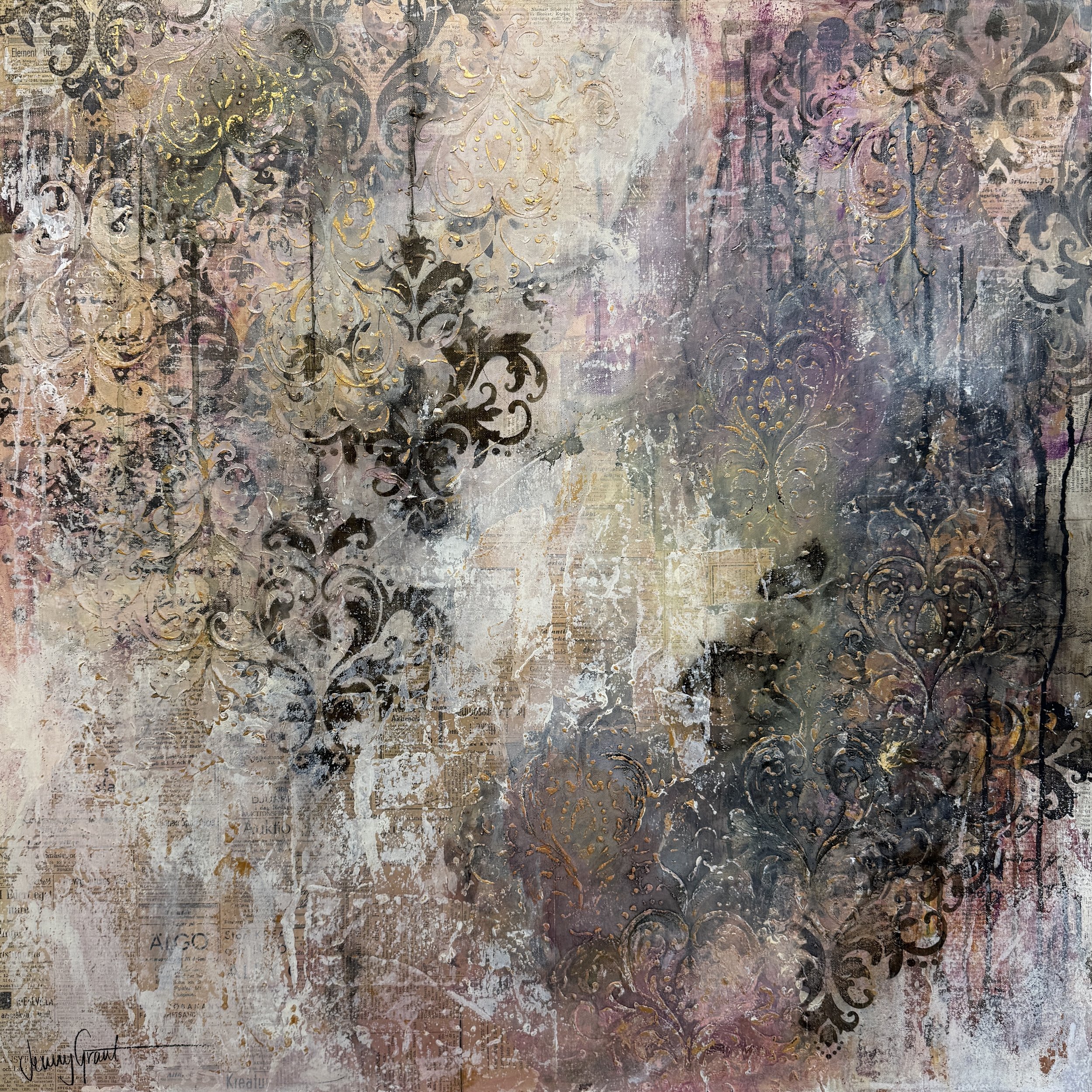
Now, I am much more flexible with what I use. It may only be a small part of a stencil rather than the whole design and I will usually use it in different directions and creating new patterns and interesting shapes and make sure the marks works with what is already there.
I might let the paint fade and then come back in another place. Sometimes I use white paint on a light background or a dark color on a dark background, creating marks that are so subtle you might not notice them straight away. I love that.
Those quieter marks can bring texture, movement and depth to a piece without asking to be the first thing you see.
Why I make my own mixed media stencils
I also love making my own stencils. Partly because I love of recycling and turning everyday materials into creative tools, but it also gives me something very important: I can make exactly the shape or pattern I want and it becomes uniquely mine.
Sometimes I don’t need a full repeating design. I might only want one particular curve, a few irregular dots or a simple organic shape that fits the painting I’m working on.
Making my own stencil means I don’t have to change the painting to suit the stencil I simply create the stencil to suit the painting.
If you’d like to try it, I have a YouTube video where I show you how I make my own stencils from simple materials. It’s a lovely way to recycle, experiment with mark making and create patterns that feel completely your own.
What designing stencils for StencilGirl taught me
Last year, I had the opportunity to design a collection of stencils for StencilGirl Products.
This had been a dream of mine for many years. I’ve loved and used StencilGirl stencils for a long time, so being invited to create my own collection felt incredibly special.
It was much harder than I thought. Marks on the canvas are easy to change and alter. Turning them into stencils made them so defined.
I wanted the marks to work as layers and guides rather than finished designs. I created a set of stencils that, of course, included a face, but also had the component marks that I often find myself returning to in my own art as I wanted them to bring interest, rhythm and depth to a painting without feeling as though they had taken over. They needed to leave space for the artist using them to incoprate them into their own story.
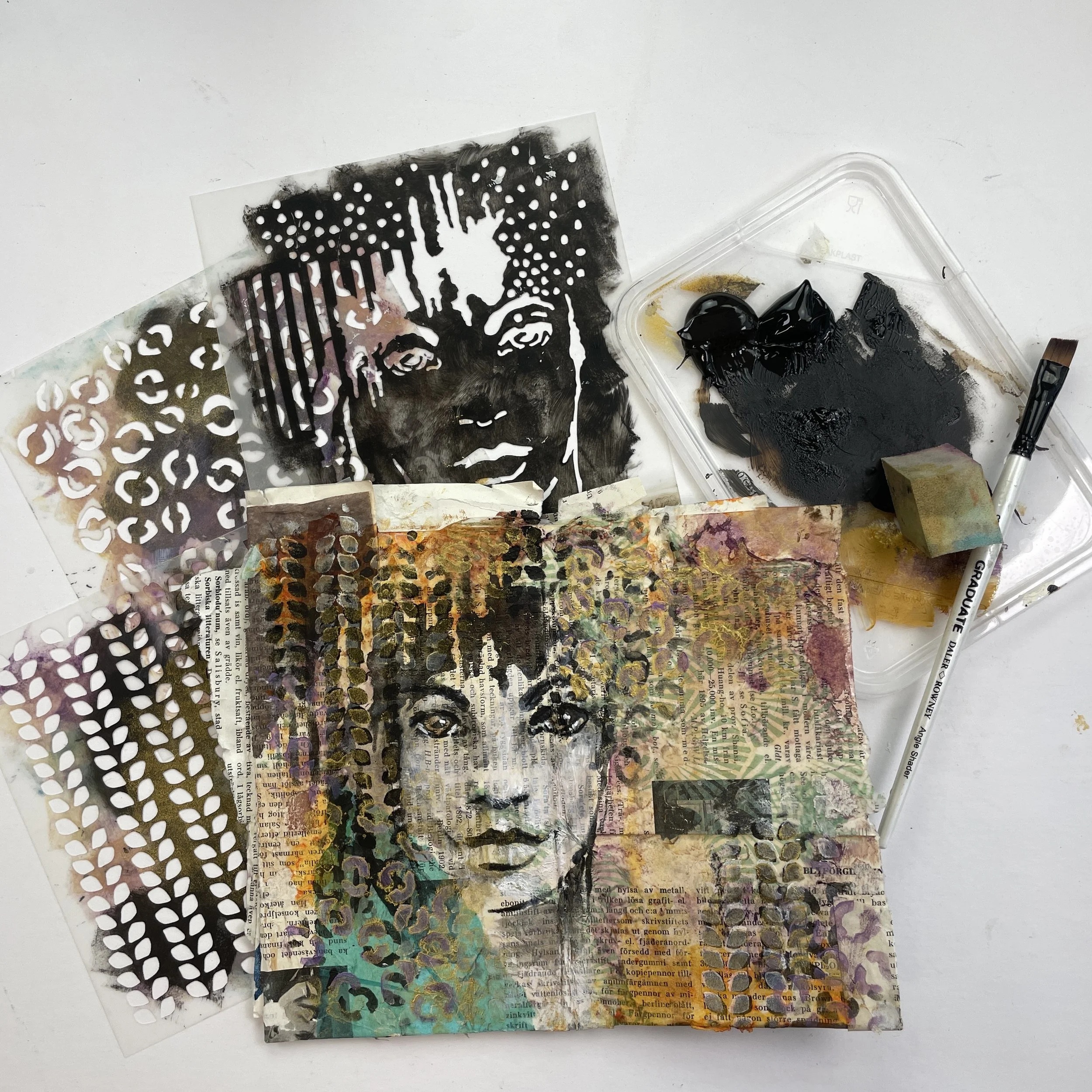
Some of my stencils from StencilGirl
How to make sure marks from your stencils blend into your artwork
The simplest way is to stop thinking that you need to use the whole pattern. Use only parts of it and repeat it to create new patterns.
Make sure you use a mix of colors when you use stencils. One color can make the stencil mark look flat. If you have a mix of colors creating the pattern the pattern will be full of life.
Add the same pattern on top of itself with different colors to create depth.
Use the same pattern in different places on the canvas and do not make the marks the same size. Use only part of the pattern in some places.
Allow some marks to fade into the background or cover some parts of the pattern to create interest.
The aim is to create marks that blends into the rest of the painting. To let them sit alongside your other marks, colours and layers rather than dominating them.
Sometimes just a hint of pattern is much more interesting than a perfect repeat.
How stencils can help you find your artistic voice
Hundreds of artists can own the same stencil, but none of them will create exactly the same painting - how amazing is that!!!
And the reason, is that your artistic voice doesn’t live inside the stencil - it lives in your choices.
The colours you use.
The amount of paint you add.
The section of the stencil you choose.
The marks you make over it.
The parts you keep and the parts you cover up.
The way you build your layers.
That is where your personality starts to appear in the work.
The stencil is simply offering you a shape or a starting point. What you do with it is where the creativity begins.
So, the next time you reach for a stencil, try not to worry about filling every space, focus on how it helps you tell the story within you. After all, that’s where your soul becomes reflected in the work.
Monthly Creative Inspiration Awaits
Finding your own artistic voice isn't something that happens overnight. It grows layer by layer, painting by painting.
Would you like to learn more? My membership Café Flow – The Art Club is full of inspiration, lessons and projects where I show how I use stencils and all of my other favourite mixed media techniques and processes. Every month you get a new project and we come together for live sessions where I share little discoveries from my own creative practice, answer questions and encourage everyone to experiment, play and trust their own creative voice. It's a lovely space to learn, grow and paint together, and if that sounds like your kind of place, I'd love to see you there. Welcome to Café Flow – The Art Club
