
When the work you love changes shape: a peek behind the scenes of running an online business
Have you ever looked at someone’s work and assumed the magic just… happens? That the social media content just comes naturally, that the website was created once and then stays that way, that the emails just flow, and that a finished class is filmed in one go from start to finish? But the truth is, so much of what you see on the front end is held up by quiet backend work, the systems, the planning, the testing, the fixing, and the people helping it all run smoothly.

As a mixed media artist and online teacher, people often imagine my working days start and end in the studio, surrounded by paint, paper scraps, and half-finished pieces.
But over the past few months, a big part of my energy has been going somewhere else.
Quietly, steadily, I have been deep in the behind-the-scenes work that keeps an online business running. The kind of work you rarely see, and you only feel when everything is running smoothly without hick-ups.
And honestly, I love to work on the technical back end.
When my focus took a turn
Back in May, I spent a few days in London, and one of those days was something I’d been looking forward to for a long time. After working together for four years, I finally got to meet Nicola, one of the wonderful Team Flow members, in person.
We spent the day talking about the future of the business, sharing ideas, exploring ways we can continue supporting the more than 23,000 amazing creatives who have come through my online art business over the years, and dreaming about what’s next.
I came home super excited, full of ideas and completely energised. The funny thing was…
None of those ideas involved painting.
Instead, I found myself sitting at my computer, happily disappearing down rabbit holes, building systems, improving workflows and solving problems. My studio became a little quieter while I spent my time by my desk. Before I knew it, days had turned into weeks and I realised I’d spent very little time painting. And rather than seeing that as a problem, I started to understand something important:
This is also work that I love and it is the work that makes everything else possible.
Can “creative work” look like spreadsheets, systems and strategy?
Most people here know me as a mixed media artist and creative guide, but what you might not know is that I have a technology background. I have been working within high tech for more than 20 years… and I genuinely loved it. I love solving problems and figuring out how all the little pieces fit together behind the scenes so everything works in the simplest way possible. I know that sounds a bit geeky, but I absolutely love it and I am a geek, I guess :)
I love taking something that feels messy and complicated and slowly figuring out how all the pieces fit together. When something finally works exactly as I’d hoped, I get that same flutter of excitement I feel when a painting comes together.
Creativity is not limited to be expressed with paper, paint or collage. Sometimes creativity looks like solving problems. Sometimes it looks like connecting ideas. Sometimes it’s thousands of tiny improvements that nobody else ever sees, but everybody benefits from.
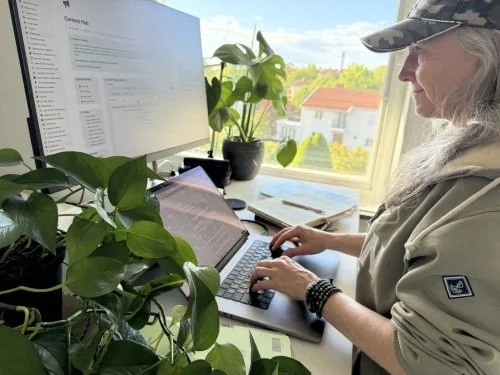
What is a tech stack?
Over the past few months I've spent a lot of time working on what's called my tech stack.
It sounds terribly technical, but it's really just a fancy way of describing all the tools that help me run my online business.
It's the platform that hosts my classes.
The system that sends my newsletters.
The place where my artwork lives online.
The way payments are processed.
The clever connections that allow everything to talk to each other.
And the place where I organise absolutely everything... My second brain as I like to call it.
It's the invisible scaffolding behind every online class, every collaboration, every video and every newsletter that lands in your inbox. It's definitely not as glamorous as painting in the studio. There has been plenty of head scratching, plenty of moments where I've asked, "Why on earth isn't this working?" and quite a few happy dances when something finally clicked into place.
And this is the bit I want to say out loud, especially if you are building something online too: When the backend runs smoothly, the front end gets to feel calm. That means more time to create, more time to teach, more time to show up, and less time firefighting.
What really goes into running online art classes?
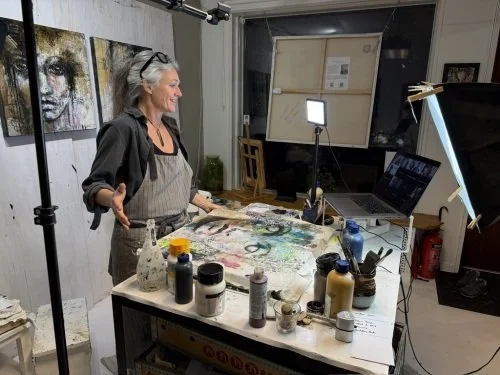
People only see the finished class. They press play, pick up their paints and begin creating, and that is exactly the point! What they don't see (or at least, they shouldn’t see) is everything that happens beforehand.
Every online art class is almost like producing a small film. There are filming days, weeks of editing, lesson plans, written guides, downloadable PDFs, uploads, testing and endless checking before anything goes live. Then there are all the tools quietly working together behind the scenes.
My website lives on Squarespace, my classes are hosted in Thinkific, Mailchimp looks after newsletters, Stripe and PayPal handle payments, Zoom helps me teach live and Zapier quietly makes lots of the clever bits happen behind the scenes. Add in video hosting, storage, backups and plenty of other moving parts and there's quite a lot keeping everything ticking over.
Each piece has been carefully chosen over the years. Some of these systems have been with me for more than a decade. Some still work beautifully, while others need updating as the business continues to grow. They're all quietly working away so that when you join one of my mixed media art classes, your experience feels simple.
You can simply press play...
...and paint.
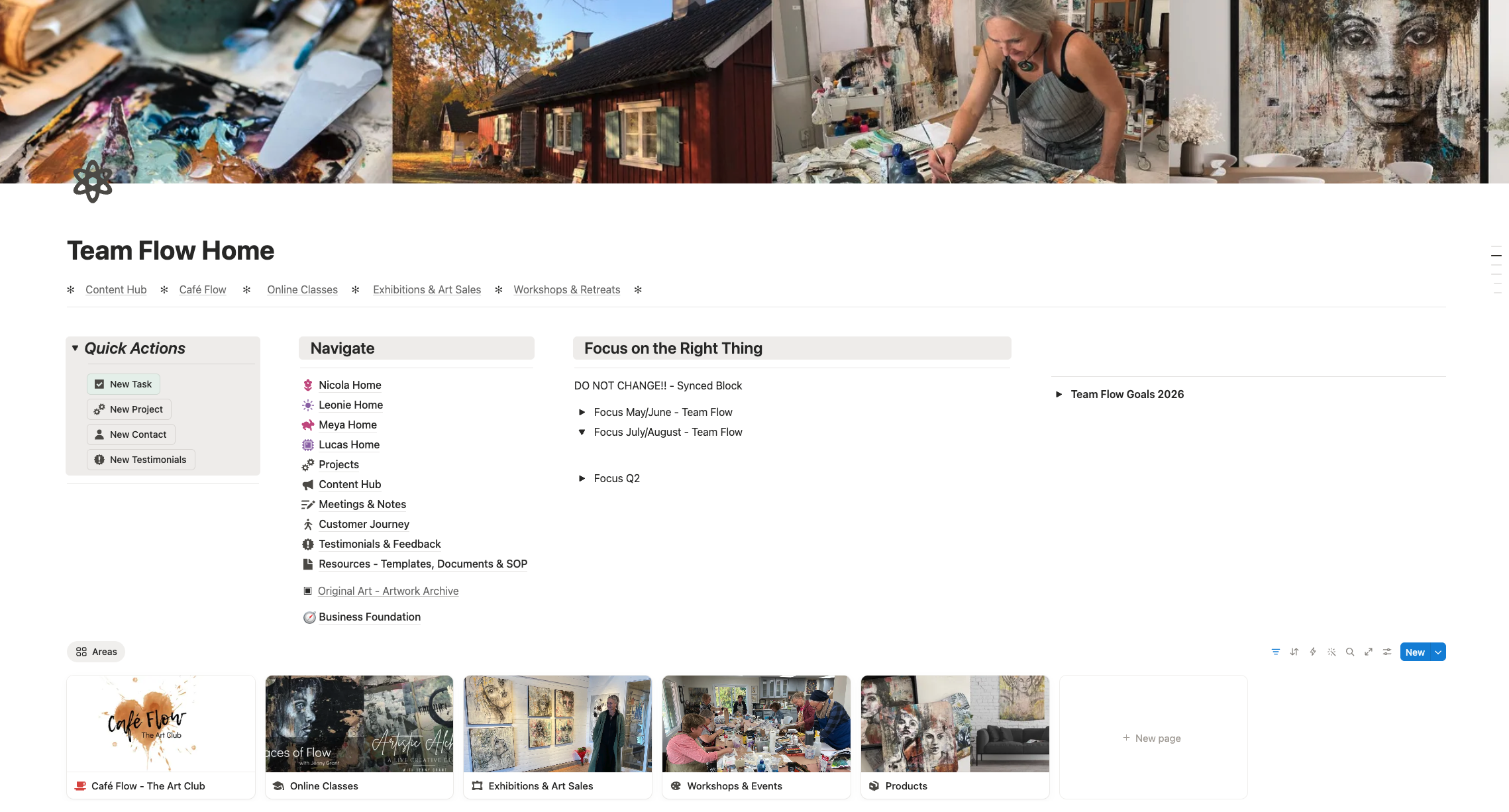
Running an art business requires a second brain
And then there's Notion. Ooohhh... I looove Notion!
It's where I've built dashboards and workflows to capture ideas, manage projects, plan my marketing and keep track of every class and product I offer. It really has become my second brain.
The funny thing is that building these systems is just like making art…
Instead of mixing colours, I'm connecting ideas. Instead of layering paint, I'm layering workflows. And just like in the studio, there is an ugly phase where nothing is working but you need to stay in it and just take the next decision and go from there. It is do, test, adjust, simplify, and try again.
Maybe I've been practising what I teach all along
This whole experience reminded me of something I say in almost every class.
When it's hard to start...
Just start with something.
Looking back, I realised that’s exactly what I’ve been doing over these past few months. Only my “starting point” wasn’t paper collage. It was a collage of small improvements. A workflow. An automation. One “let’s fix this so it feels easier next time”. Little improvements that slowly built into something bigger.
And I’m so grateful I followed what was lighting me up instead of forcing myself to work in only one way. Because whether you’re building an art practice, or building an online business (or both), the work is allowed to change shape. Sometimes that path begins with a scrap of paper.
And sometimes…
It begins with an idea infront of the laptop.